


Intuiting Life
October 14, 2023 @ 10:00 am - 12:00 pm PDT
October 14, 2023 @ 10:00 am – 12:00 pm PDT
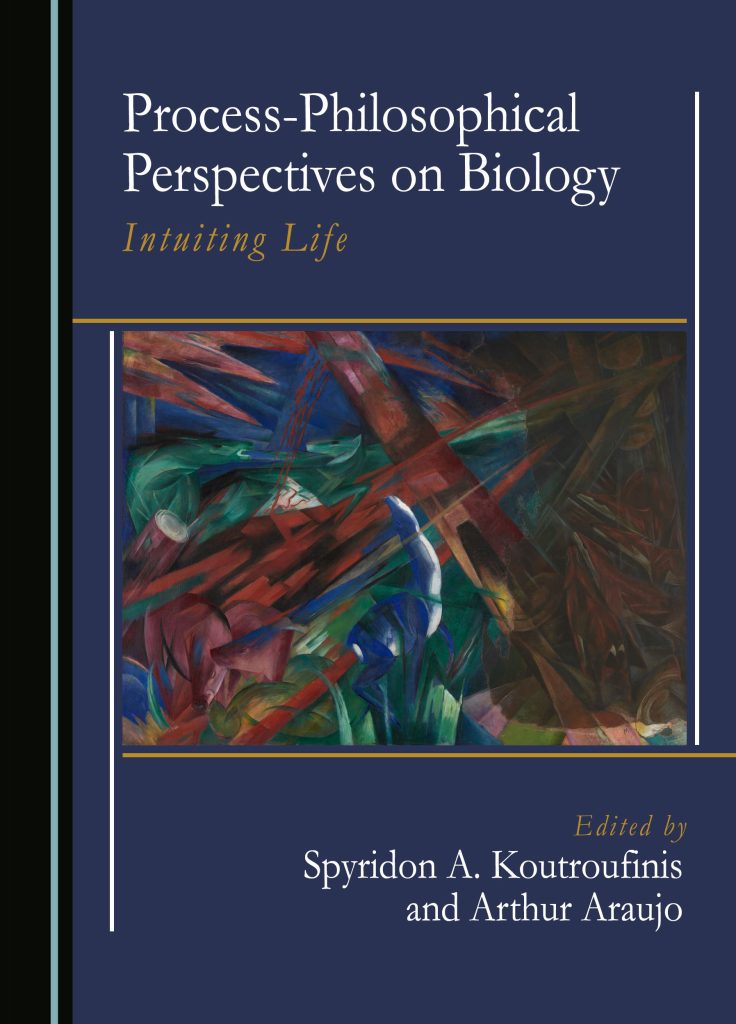
The Science Advisory Committee at the Cobb Institute invites you to join us for a conversation series with the editors and authors of Intuiting Life: Process-Philosophical Perspectives on Biology. Each session will feature presentations by two or more of the book’s contributors and conversations with all attendees. RSVP below to receive the Zoom information.
Schedule
- October 14: Arthur Araújo (co-editor), Federico Giorgo
- October 21: Philip Tryon, Johanna Häusler, and Nathaniel Barrett
- October 28: Spyridon Koutroufinis (co-editor), Matt Segall
About the Book
This book challenges the reductionist, materialistic metaphysics often adopted by biologists, arguing that this approach overlooks the intricate complexities and essential characteristics of life. Instead, the authors propose a process-philosophical approach, grounded in the metaphysics of Alfred North Whitehead and other process thinkers, which attributes subjectivity, value, and purposeful striving to all organisms, from simple cells to complex animals. This fresh perspective aims to provide a more nuanced understanding of fundamental biological concepts such as organism, development, agency, goal-directedness, and environmental interaction.
“Whitehead is convinced of the ontological fundamentality of life in all of nature. He considers the problem of life to be the central question of science and philosophy. He insists that the basic principles of life are exemplified in rudimentary form in all forms of physical existence. Living nature can give us the key to understanding non-biological nature.” (Intuiting Life, 31)
Scientific intellectual attitudes criticized by Whitehead and Bergson dominate the modern life sciences. They are particularly influential in one of the core problems of contemporary biology and philosophy of biology: the nature of explanation. In 20th century philosophy of science Carl Hempel’s theory of explanation was for decades the backbone of theorizing about scientific explanation. . . . In philosophy of biology there is broad consensus that the explanative relevance of biological modelling in contemporary biology—especially in mathematically operating systems biology and theoretical biology—cannot be captured by Hempel’s account.
As “life scientists commonly seek to uncover the mechanism responsible for the phenomenon of interest” (Bechtel and Abrahamsen 2010, 322), in the life sciences phenomena are explained by mechanisms. Leading philosophers of science who advocate a school of thought that is often described as ‘New Mechanical Philosophy’ or ‘New Mechanism’ argue that in many fields of science what is considered a satisfactory explanation requires providing a description of a mechanism. Indeed, much of the practice of science can be understood in terms of the discovery and description of mechanisms. Mechanistic explanations form the main theoretical basis of most, if not all, contemporary biological disciplines.
The neo-mechanistic school in biology is a specific manifestation of what Whitehead calls “scientific materialism.” It can also be seen as a typical product of the technological intellect striving to reduce reality for the purpose of manipulating it, against the limitations of which Bergson warns. Some authors’ criticism of the biological relevance of mechanistic explanations echoes Bergson’s warning mentioned above: “The intellect is characterized by a natural incomprehension of life.” Consequently, intuition must assist the life-studying intellect, for only intuition can do justice to those aspects of life, which, for fundamental reasons, transcend the discursive-analytic modes of thought. Intuitive knowledge is not the only conceivable response to neo-mechanistic thinking, but it is certainly one that takes into account essential facts that neo-mechanicism simply ignores.
Philosophy, and in particular process philosophy, must breathe new life into what has been suppressed by scientific reductionism. Serving this purpose, the present volume is committed to the following maxim: Starting from philosophical intuitions, biophilosophy must unveil the abstractions of biology and overcome them with new metaphysical hypotheses.
“[A]ll of [Whitehead’s] thinking draws from the following philosophical intuition: The main aim of contemporary metaphysics should be to resist the modern dogma that a truth cannot be scientific unless it hurts the deep intuitions of mankind, and that we cannot be scientific unless we tame the authority of our intuition. […] Whitehead’s philosophical work can be seen as an alternative to the worldview that still prevails in the natural sciences of his and our time, which arose in the 17th century and is described by Whitehead as ‘scientific materialism’.” (Intuiting Life, 21)
Presenter Bios
Arthur Araujo has a PhD in Philosophy from the Federal University of Rio de Janeiro/Brazil (2001). He is currently a professor at the Federal University of Espirito Santo/Department of Philosophy (Brazil) and founding member (2016) and current Coordinator of the Semiotics Brazilian Association of Post-Graduation in Philosophy (ANPOF). His teaching and research focuses on Philosophy of Mind and Philosophy of Biology, especially William James, Uexküll, Peirce, Ryle, Austin, Wittgenstein, Darwin, and Whitehead.
Nathaniel Barrett is a research fellow and member of the Mind-Brain Group at the Institute for Culture and Society (Pamplona, Spain). The main focus of his research is the nature of value and its role in experience, mind, and life, especially as examined from the perspectives of pragmatism, process philosophy, and ecological psychology. His recently published book, Enjoyment as Enriched Experience (Palgrave, 2023), draws on the philosophies of John Dewey and Alfred North Whitehead and recent scientific research to develop a theory of affect as the enrichment or deterioration of conscious activity.
Federico Giorgi is a doctoral student at the University of Namur (Belgium). His doctoral research concerns the relevance of Whitehead’s theory of symbolism to the present-day philosophy of perception. Giorgi’s interests include process philosophy, philosophy of film and artificial intelligence.
Spyridon A. Koutroufinis is Privatdozent (Associate Professor) for philosophy at the Technical University of Berlin. Between 2012 and 2014 he was Visiting Associate Professor at the University of California, Berkeley. He has specialized in process philosophy (Whitehead, Bergson), biophilosophy (Canguilhem, Uexküll et al.), classical metaphysics (Aristotle, Leibniz) and complexity theory. His research focus is the establishment of a new theory of the biological organism based on process ontology. He is the author and editor of six books and numerous articles and book chapters.
Johanna Häusler studied biology and philosophy in Munich and works at the LMU in science communication. She currently writes her PhD in Philosophy about the problem of free will, arguing for a libertarian account of freedom in a broadly Whiteheadian spirit. Her philosophical interests cover a wide range of topics like philosophy of mind, the free will problem, the philosophy of science, theories of causality, the philosophy of biology as well as classical metaphysics.
Matthew David Segall is a transdisciplinary researcher, author, and teacher applying process philosophy across the natural and social sciences, including the study of consciousness. He is Associate Professor in the Philosophy, Cosmology, and Consciousness Graduate Program at California Institute of Integral Studies in San Francisco, CA. He is the author of many articles and books including Crossing the Threshold: Etheric Imagination in the Post-Kantian Process Philosophy of Schelling and Whitehead (Revelore, 2023) and Physics of the World-Soul: Whitehead’s Adventure in Cosmology (SacraSage, 2021).
Philip Tryon did his graduate work in physics at the University of Wisconsin, subsequently working as a development engineer on early automation projects for BioTek. He has a lifelong interest in quantum mechanics and how it relates organic systems and informs biological science.
RSVP to receive Zoom Info
To receive the Zoom info for this event, click the Going button and enter your name and email.