
Eric Ross
- Eric RossParticipant
“Insofar as he makes use of his healthy senses, man himself is the best and most exact scientific instrument possible. The greatest misfortune of modern physics is that its experiments have been set apart from man, as it were, physics refuses to recognize nature in anything not shown by artificial instruments, and even uses this as a measure of its accomplishments.”
– GoetheAs much as I admire the accomplishments of science that have expanded humanity’s knowledge of the macroscopic and microscopic worlds, I wonder if there is a danger in decentering from the anthropomorphic perspective.
Those who truly understood the realms of the large and the small, brought us both atoms for peace and atoms for war. Once these tools were in the hands of politicians, the scientists responsible for developing them had very little say in their use (see the movie “Oppenheimer”). While science in the abstract leads to the expansion of human knowledge, science in practice leads to the development of technologies that can be used for either good or evil.
One aspect of this course that has not been emphasized is how science invariably leads to the development of technology and how technology invariably is exploited for military or commercial purposes. The absolutely bewildering array of goods available to us today as compared to 200 years ago, created at a cost to the environment, is in large part made possible by science exploring what is beyond the senses and technology exploiting that knowledge. Is it possible one of the byproducts of our preoccupation with these products is “meaning crisis”? Have we forgotten what does it mean to be human?
Another question is whether the new understandings of science revealed by the extending senses, say with relativity and quantum theory, have muddied the philosophical space. I’m uncertain how well many of us really understand these theories, few of us have a working knowledge of them. Yet we pepper our conversations with ideas drawn from those theories and we feel the need to make our philosophies “consistent” with the findings of science. My concern here, is by introducing ideas from realms beyond “first hand experience”, that we try too hard to accommodate things we simply have heard from others, bowing to what we think consensus sciences says. We have a blind faith in science where perhaps it isn’t warranted. (That said, I accept the public health recommendations of the scientific community, over those of RFK).
One way I reconcile this for myself is to consider how Whitehead uses “objects” in his schema. We know “eternal objects” are “pure potentials” that influence actual occasions and the nexuses they participate in. Isabelle Stengers offered other ways of breaking down objects, for example into “sense objects”, qualities such as color or shapes that form our sense impressions, and “intelligible objects”, things we recognize. I’m willing to bag scientific theories into “scientific objects” and classify the now sleeping, now awakened gods under “god objects”. So scientific theories about the large and the small, do not hold sway over the gods. And the gods do not hold sway over science. Whether the gods still hold sway over humanity in some shape or form is an open question.
- This reply was modified 11 months, 4 weeks ago by Eric Ross.
- Eric RossParticipant
Could Philosophy of Organism be renamed Philosophy of Actual Entity or perhaps Philosophy of Actual Occasion?” (A contribution to the week 1 discussion).
An organism is more generic than an actual occasion or actual entity. It is one of the bridge terms that carries us over from the micro world of actual occasions/entities to the macro world of societies of occasions of a character that constitute living organisms. An actual occasion is an organism, as is a nexus that constitutes a living society.
I wonder if Whitehead had used the sub title ‘“A Philosophy or Organisms”, whether that might have helped clarify what he meant. Organism implies a categorial schema, while organisms suggests a diversity or plurality. Also the singular version points to a whole, while the plural version emphasizes the parts. An ecosystem is characterized by the organisms that inhabit it. Considering whether the ecosystem itself is an organism requires further consideration.
What other terms might he have used?
Here are some candidates with the most relevant “Dictionary.com” definition.
Organism – “a form of life composed of mutually interdependent parts that maintain various vital processes.’ The latter part of the definition with interdependencies and processes sounds spot on with what Whitehead meant. A form of life seems off because we assume the biological organisms that constitute life look a certain way. The life cycle and metabolic activities of a biological organism differ from those of an actual occasion. Actual occasions are not born from parents and they don’t eat or excrete. What biological organisms do share with Whitehead’s more generic definition is both have a “life span”, they exist for a limited duration and then perish.
Entity – “something that has a real existence; thing.” I like “entity” as a nice neutral term. However since it includes things, maybe “living entity” might be closer to what Whitehead envisions. “Animated entity” also is close, but today we think of atoms as being both animated and wand enduring, unless split apart by high energies. Animated entity catches the activity but leaves out the temporal duration.
Experience – “the process or fact of personally observing, encountering, or undergoing something.” William James talks about “droplets of experience”, but who or what is experiencing? The same question arises with pan-experientialism. Experiencing seems to be a feature of organisms themselves.
Event – “something that happens or is regarded as happening; an occurrence, especially one of some importance.” Experience consists of events, and as mentioned, it seems hard to separate an experience from an entity that experiences.
Being – “that which has actuality either materially or in idea”. Being or beings have abstract implications Whitehead is trying to avoid. An “absolute existence in a complete or perfect state, lacking no essential characteristic; essence.”
Holon (1964) – “is something that is simultaneously a whole in and of itself, as well as a part of a larger whole.” Holons also have been assigned interiors and exteriors lending them a subjective dimension. I think this term would have been useful to Whitehead if it had been available to him. However the notion, like being, or entity, lacks the element of temporality implied by “organism”. AI suggested the term “dynamic holon” to capture the temporal dimension of an actual occasion.
It seems difficult to replace Whitehead’s organism with another term that equals it in scope and breath.
- Eric RossParticipant
Hi Dennis,
Well what are your alternatives? Materialism, Dualism, Idealism, and Panpsychism. Those four philosophic ‘isms’. Seems like Alex was willing to slip from one to the other depending on the target audience or perceived need. Grant proposals – materialism. teaching dialectic – dualism, unifying theories – idealism, awe and wonder – panpsychism. Like a sophist, he uses the perspective most useful in the given context.
I don’t think the terms panpsychism or panexperientialism really does justice to Whitehead’s thinking. It’s easy enough to assign interiors to entities and that is often done in idealist systems. This interiority doesn’t stand on its own, it is like an attribute added to the structure of an entity. Generally the point of an idealist system is to realize some great overarching truth, whether that be Spirit, the Absolute, God, Suchness or Emptiness.
Whitehead doesn’t do that. Instead, he comes up with a system of ontological participation, where you sense feelings that you share with other entities, which explains how you are related to them. His intuition into the nature of things and the feelings of actual occasions aligns with my own feelings of self awareness. I am utterly different from an actual occasion, but I sense solidarity with its experience.
If you have “one foot in and one foot out”, may I suggest you hash out the alternative with Auto Matt, the AI Philosopher? Practically as good as sitting down with ANW or Matt Segall himself. (Working with it really makes you slightly fearful for the future of philosophy produced by human beings)
https://chatgpt.com/g/g-pEzRXgMt7-auto-matt
My own session was very therapeutic. Over the years I’ve admired Ken Wilber’s Integral Theory. After hashing it over with Auto Matt, I could see its shortcomings as an Idealist system. In Wilber’s Kosmos, holons (whole/parts) are arranged in hierarchies that float on Emptiness. Wilber’s Kosmos thus tends toward an epistemic integration—mapping phenomena into a grand theory of everything—whereas Whitehead’s organism is an ontological participation: a “descendental realism” (Segall’s term) concerned not with abstract unification but with “the fusion of analysis with actuality”. Auto Matt and I had great fun refashioning Integral Theory in process terms, coming up with “dynamic holons” as a stand-in for actual occasions, and a “possibility manifold” for eternal objects.
- Eric RossParticipant
Hi George,
I must confess that in 40 years of programming, and maybe 15 years of process studies, I’ve never really made the connection between the two. What you’ve done is quite creative!
What was a big shift for me earlier in my career was picking up on the “object-oriented” programming paradigm. Instead of having one large program handling everything, the code was broken up into classes that served as templates for objects with specific behaviors. These objects model real world entities, and interact with one another through specific behaviors. I guess you could say that paradigm was more “process-relational” than the old monolithic program approach.
While the class or template might be considered the “eternal object” and the object the “actual entity”, what for me is the breakdown with this example is the actual entities have no freedom to do anything other than what the eternal object dictates. That’s why I find “neural net” or “machine learning” models a little closer to what Whitehead might have envisioned. How a machine is able to take patterned input from a photo or video, and recognize it as let’s say a specific individual’s face, is beyond amazing. The equivalent in Whitehead’s philosophy would be taking a complex pattern of actual occasions and associating it with an eternal object and making a true proposition.
On a side note, for a while I found the work of Stephen Wolfram on computational irreducibility interesting. Aspects of his work are analogous to process thought. Computational irreducibility suggests certain computational processes cannot be simplified and the only way to determine the outcome of a process is to go through each step of its computation. These programs can produce unexpected beauty and creativity in their output! But that is only discovered by running through many iterations. This might be analogous to continuous creative advance. I think the divergence from Whitehead is that all the novelty is derived from initial conditions and imposed rules. In Whitehead novelty is a possibility at every moment.
- Eric RossParticipant
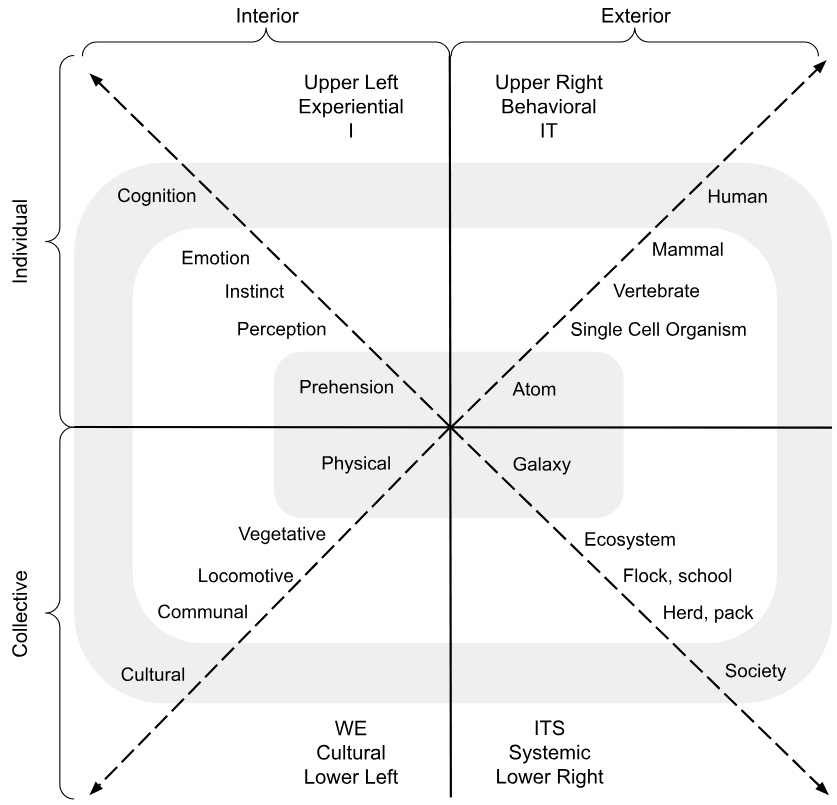
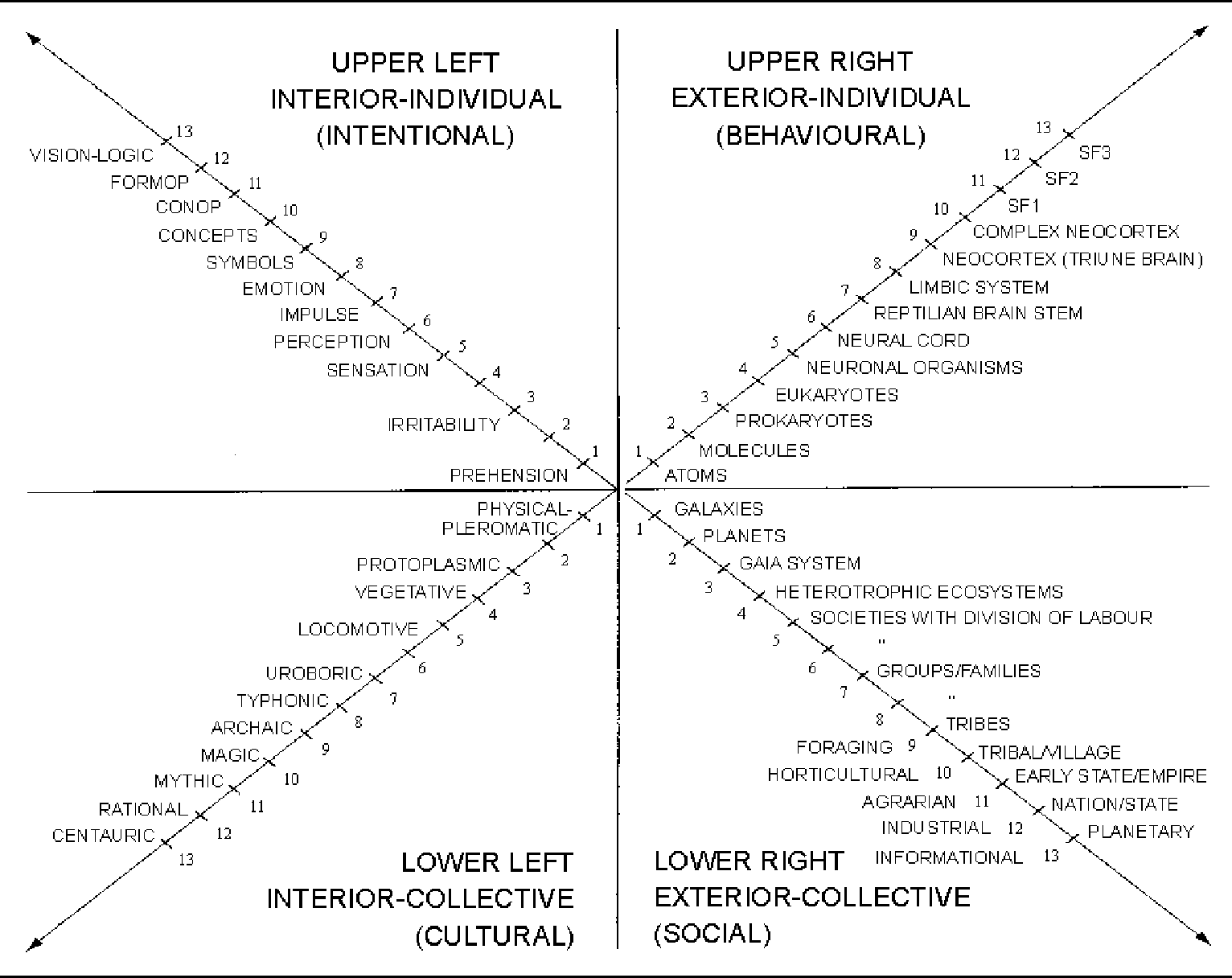
I’m not sure Whitehead does an adequate job explaining how “societies of occasions” are related to each other. If societies form intelligible objects, intelligible objects can be assembled into structures that form new societies with emergent behavior. Integral theory uses the concept of a holon to describe that process. Holons are whole/parts with interiors/exteriors. The model of the Kosmos orders entities defined by science into a holoarchy.
A critique of the Integral model is that it’s static and lacks the dynamism of Whitehead’s philosophy of becoming.
https://mattsturm.substack.com/p/a-friendly-primer-on-integral-theory
- Eric RossParticipant
How do you ‘realize’ your understanding of Whitehead’s philosophy in your everyday real-world life? How do you put the theory into practice?
By separating out how I personally experience the world, from my scientific beliefs about the world, from my philosophic understanding of the world, effectively tri-furcating nature. What I call my philosophic understanding might be for others their religious beliefs, their mythos, their world view, their ground of being. Whatever this is called, it is consistent with personal experience, and stands prior to a scientific understanding.
I rather dislike mixing science and process thought. Entities defined by science are what most of us are educated to take as being “really real”. Atoms, molecules, cells are the stuff of reality. We’re so used to assuming science explains everything, that we often presuppose science can explain things it hasn’t. For example, I assumed an animal’s form was determined by its DNA. But as Michael Levin explained, DNA only gives instructions on how to generate proteins. How the animal takes a given form is still a mystery.
Whitehead has a different starting point than science, an abstract moment of experience called an actual occasion. This is what he claims is really real. Only when these are bound together into societies do they become intelligible objects, the entities familiar to science. I take nexuses to be sensual objects, the qualities or attributes that make up an intelligible object. Much of the “philosophy of organism” deals with activities apriori to presentational immediacy, clear and distinct impressions, intelligible objects, existence in space and time, all starting points for science. Therefore I believe Whitehead’s philosophy serves to make a larger contribution to new psychological, philosophical, and theological models, than it does to scientific models. However, it does have a bearing on the ethics of applying science to develop new technologies, which may or may not be beneficial to human kind.
A practical aspect of embracing Whitehead’s philosophy is an increased empathy for those with more traditional world views. I can understand where they are coming from. Their starting point differs from mine, but there is enough breadth in Whitehead’s philosophy to accept their view points fit into a larger scheme of things.
- Eric RossParticipant
Rolla asked me to pass the paper on to Matt Segall for review. Before I did I revised it, so I’m posting the updated version here.
Matt did respond with a critique that was kind and encouraging.
Our weekly Zoom discussion discussion continues. A member of the group had a question about holons and the Four Quadrants so I’m posting a more detailed picture here:
- This reply was modified 2 years, 1 month ago by Eric Ross.
Attachments:
You must be logged in to view attached files. - Eric RossParticipant
Hi Mark,
In calling human beings actual entities, I’m going with Matt’s interpretation expressed here: https://cobb.institute/forums/topic/do-mathematical-laws-or-eternal-objects-function-as-forms/
Whitehead’s actual occasions, which are not to be imagined as little quantum events that add up to larger things. The “actual entity” is a scale free metaphysical category meant to describe any process of actualization, whether quantum or atomic or biotic or psychic.
I’m arguing that the experience of a human being, a human life, is a process of actualization.
Does the future of process philosophy lie in the hands of debates between bots or large language models?
Here is another ChatGPT take:
What is an actual entity?
An actual entity is a complex, self-determining process that integrates various influences from its past and contributes to the formation of the future. They are interconnected in a web of relations, and their nature involves a process of becoming, where they experience, evaluate, and integrate various possibilities before they become actualized.
Is a human being an actual entity?
Yes, in Alfred North Whitehead’s philosophy, a human being can be understood as a collection of actual entities. Each moment of experience and interaction that constitutes a human being is an actual entity. A person, as a complex organism, is seen as a series of interconnected actual entities, each of which contributes to the ongoing process of becoming that defines a human life.
Even in the ChatGPT quote take you gave:
Each moment of a person’s experience, each pulse of feeling, thought, or perception, is an actual occasion.
It looks like you accept momentary human experiences may be actual occasions but when you put them together, they are societies of occasions only. These momentary experiences can not be summed together to form a unified, larger experience, a process of actualization. I tend to use the term actual occasion to refer to momentary experiences, and the term actual entity to refer to a society of occasions that might form a larger unified, experiential whole. I’ll have to read Whitehead more closely to determine if this is acceptable.
Another way of looking at this is to ask is momentary human experience holonic? Is it something that is simultaneously a whole in and of itself, as well as a part of a larger whole?
- Eric RossParticipant
Hi Charlie,
I think we determined a human falls into the metaphysical category of an actual entity and a human experience into the category of an actual occasion, even if the actual entities and occasions Whitehead describes are much more abstract. Although Whitehead derived his system by generalizing from human experience, he left it in large measure to others to find humanist applications for his system. More progress has been made in challenging prevailing paradigms in the hard sciences, than in the social sciences. Biology is somewhere in the middle and economics and ecology are relatively untouched. This mapping issue of the specific to abstract and back to the specific reminds me of Matt’s project to use AI to translate Whitehead from English to Chinese and then back to English. I’m sure the resulting texts are amusing rather than accurate.
Regarding eternal objects, I really feel the prevailing opinion about what constitutes EO’s is excessively limited. I brought up the question in this Session 1 post: https://cobb.institute/forums/topic/stretching-eternal-objects/
And in reply to your Session 1 post: https://cobb.institute/forums/topic/how-do-eternal-objects-relate-and-unify-occasions/
Matt gives us Whitehead’s perspective:
This is a very good question that requires going a layer deeper into Whitehead’s categoreal scheme (as he refers to it in Process and Reality). It turns out there are two species of eternal objects: 1) objective eternal objects, which are what mathematical physicists are concerned with (eg, spacetime coordinates, charge, mass, etc.), and 2) subjective eternal objects, which is what poets are concerned with evoking (eg, the greenness of the grass, the blueness of the sky, the warmth of the sun, etc.).
If this is what eternal objects are limited to, I think we’ll have a very tough time applying Whitehead’s system to the humanities and social sciences. Should we really allow their range to be defined solely by the perspectives of physicists and poets? Plato’s ideal forms seem much more open-ended as to what is permitted, basically any universal category that humans use in language. When ChatGPT compares the Plato’s forms with Whitehead’s eternal objects, it states:
Unlike Plato’s Forms, eternal objects are not perfect ideals that the physical world imitates. Instead, they are potential characteristics that actual entities can actualize, leading to the creation of the actual world.
This points to a difference in the ontological status of the forms and eternal objects, but not necessarily a difference in what might be considered a form or eternal object. The question is how limiting are “potential characteristics”? If they are broad enough to allow us to identify what we see in the world when we use language, and be able to agree and communicate, then I think eternal objects can include every worthy idea humanity has ever had and expressed. Those of the past may not pertain to the current circumstances, but are still potentially available. Doesn’t Whitehead challenge modern assumptions of guiding rationality, and encourage a more organic conception of culture? Didn’t some cultures of the past embody that organic conception? Modern Chinese efforts to revitalize Confucianism is an effort to work along such lines. I think a wider conception of what constitutes eternal objects would go a long way towards rendering Whiteheads thinking more useful to humanism and the social sciences.
- Eric RossParticipantJuly 30, 2024 at 6:48 pm in reply to: Do mathematical “laws” or eternal objects function as Forms??? #29147
This lack of clarity is what drives me “nuts” about Whitehead, whether actual entities are a “scale free metaphysical category meant to describe any process of actualization”, or whether “societies are composed of actual entities” and “a person is a society rather than a single actual entity”. It would have been nice if Whitehead had access to the concept of a holon (known to me through Ken Wilber), a whole/part that can be used to compose other greater whole/parts. Did he state anywhere that a “living society” could be considered to be an “actual entity” in its own right? Instead of opting for the “Russian doll” approach with nested levels of actualization, he seems to have opted for the cinematographic route where societies are like images on a screen composed of pixels of light representing real actual occasions.
Maybe he has his cake and eats it too, using actual occasions in either context when it suits his purposes. I know somewhere along the line of courses, after thinking I understood Whitehead in the first context, I read this piece by Paul Schmidt:
https://www.openhorizons.org/does-anything-really-move-a-question-for-whitehead.html
After reading that piece, I decided I didn’t really understand Whitehead at all, and I would be better off treating his system as a model, than an actual description of reality. At least with a model you can use the parts you like and find useful, while discarding the parts that you don’t.
This whole discussion reminds me of a medieval term for a key problem in learning geometry. Pons asinorum (“bridge of asses”) is used metaphorically for a problem or challenge which acts as a test of critical thinking, referring to the ability to separate capable and incapable reasoners. Its first known usage in this context was in 1645.
- Eric RossParticipant
Hi Mark,
Thanks for the response. I especially like this, “While Whitehead’s system could conceptually support the notion of socially constructed gods within the infinite potential of eternal objects, there is no place for independent gods.”
Makes one wonder if “spacetime coordinates, charge, mass, etc” are the social constructs of modern science or independent entities? Of course physicists as a practical matter treat them as independent entities. And Whitehead would seem to concur. All of these were envisaged by Primordial God. Humanity “discovers” these entities by doing science. Of course the constructs of modern science are very abstract.
The physicist Richard Feynmann poked fun at the Princeton Whiteheadeans when they asked him whether an electron was an “essential object”. Thinking “electrons” are too abstract, he turned the question around and asked, is a brick an essential object? (Essential object is how Feynmann mistakenly remembers what I’m fairly certain was Eternal object). And he got a variety of answers, concluding philosophers don’t know what they are talking about. Story here:
BRICK, or «ESSENTIAL OBJECT»: from a book of memoirs by the Nobel laureate Richard Phillips Feynman
Ask ChatGPT and the answer is simple: “In Alfred North Whitehead’s process philosophy, a brick is not an eternal object. Instead, a brick is considered to be an actual entity or more precisely, a collection or society of actual entities.” But the idea of a brick is another matter, it is considered an Eternal object.
Twenty hundred years ago Egyptians worshiped the gods Horus (falcon), Anubis (jackal), Seth (dog?), Hathar (cow), Re (Hawk), and Throth (ibis or baboon). Were these gods social constructs or independent entities? I’m sure for the people of that time and culture they were independent entities, as real as electrons are to us today. Are they too eternal objects? Gods are rather abstract, so like Feynmann, I want to ask about something more concrete. Are the animals representing these Egyptian gods Eternal objects? And the ChatGPT gives the answer above. A particular dog is not an eternal object, However the idea of a dog (represented by the god Seth) is.
BTW on identifying eternal objects, I think ChatGPT is spot on. Perhaps simply because I agree with its answer. It hallucinates more on historical questions. Russell and Whitehead did not develop process philosophy together.
Why am I bringing up the ontological status of archaic gods in Whitehead’s cosmology? Because whatever ontological status they have, I believe can ultimately be applied to traditional and indigenous gods as well. And I’ll argue that traditional, archaic, and indigenous civilizations were ecological civilizations, unlike modern industrial, capitalist society. So what Eternal objects are available to Whitehead’s God to lure and persuade us towards a better future? Only the constructs of science? Or are gods available to us too?
- Eric RossParticipant
It’s hard to judge American society in the past by standards of today. It was simply at a less mature level of moral development. Manifest destiny was the vision. America then was about energy and power as well as order, authority and conformism. Today we have moved on to rational thinking and achievement while adding harmony and connection. See Spiral Dynamics theory https://tmetric.com/spiral-dynamics-theory. According to Spiral dynamics, although we are now at a higher stage of cultural development than much of the rest of the world, there is no guarantee that we will continue to evolve from here. In fact there is a real danger we’ll regress, especially if we don’t deal with environmental concerns.
One way the Anglo Americans justified their actions in Andrew Jackson’s time was through John Locke’s idea of Natural Rights: life, liberty, and property. Note how the writers of the Declaration of Independence deftly substituted pursuit of happiness for property. Why did John Locke include property? He felt individuals owning property would labor to improve it and make it more productive, for example by planting crops. He felt that property owners were entitled to the fruits of their labors. It was the government’s duty to protect those rights, including that of property.
Oddly, he noted indigenous people also have natural rights. In a state of nature, individuals are free and equal, governed by natural law, which dictates that they should not harm others in their life, health, liberty, or possessions. What they lack is a social contract, a government to protect their rights.
Today, there are around eight billion people on the planet. Back in Jackson’s time, just over one billion. Deep ecologists hold that the natural world would thrive if we could return to a population of one to two billion, as it was between 1804 and 1927. But note when we were last at those levels, there was colonialism, genocide, wars, and species extinction. If we return to lower population levels in the future, let’s hope we have learned something from the current crisis, and live more harmoniously than we did in the past.
- Eric RossParticipant
Hello Rolla,
On the course page it listed three ways to meet the requirement for the Springboard project: Produce one of the following: (1) research paper; (2) creative localization project; (3) work of art.
Also: The culminating experience of the certificate program provides an opportunity for participants to integrate and synthesize various aspects of the subject matters they studied within the program. This experience may take the form of an academic research paper, a creative localization project illustrating the application of process thought, or a work of art (including a performance) with substantial commentary.
Is my understanding correct that you are encouraging us to do (2) or (3) and not (1)? Or is (1) still a possibility?
If (1) is possible, can a research paper have a more relaxed format and include personal observations and experience? Typically I think of an academic research paper having a formal and restricted format: thesis,key topics, arguments, and evidence.
Thank you.
- Eric RossParticipant
Here is John Cobb’s introduction to the course “Probing Process and Reality”, entitled “Why Whitehead?”
It comes as close to an “Idiot’s Guide” as I can imagine. Skillfully avoids using the terminology. However, he seems to limit his invitation to study Whitehead to those with an interest in cosmology. Not sure how many Americans have a deep interest in the topic. Of more interest to most Americans are politics and economics, followed by environmental concerns. Whether process thought can be extended to find applications beyond cosmology into these areas is an open question.
Religion shares an interest in cosmology with process thought. The course “Probing Process and Reality” was a cooperative effort between the Cobb Institute and Tripp Fuller’s Homebrewed Christianity. Although it was offered in 2020, I think you can still sign up for the videos today. Anyway, if process thought is ever going to find its way into middle America, I suspect it will be through aspects of process theology making its way into the churches. Tripp is a leading light in offering alternatives to traditional understandings, and bringing them to a wide audience through the internet. He encourages his listeners to think, and if they think, perhaps that’s all we should ask or expect.
- Eric RossParticipantJune 15, 2024 at 1:00 pm in reply to: “There Are Alternatives” Imaginative Process and EcoCivilization #27638
Hi Joel,
As a member of the baby boomer generation I’d like to apologize for not addressing global climate change effectively over our lifetimes. The= work of implementing systematic change and dealing with the consequences of our actions is going to be left to the younger generation.
At the same time, I see hope that our profligate ways can be amended. Despite all the criticisms of social media, I do see it as providing new channels for creative expression. I have been exposed to lifestyles outside the corporate mold. I may never climb rocks like Alex Honnold, but I can admire his accomplishments and ethos on YouTube. Social media has democratized media exposure and provided a chance for many more to have their voices heard.
I’m fairly certain most first users of AI have done so for personal goals. Perhaps in the long run AI can help us in creating new social policies that will benefit more of humanity. We need alternative metrics for measuring human happiness, other than the standard ones coming out of economic models such as productivity and Gross National Product. The success of corporations should not be measured only by profitability, but also by their social and environmental impacts. Perhaps AI will be useful in modeling the impact of these additional metrics. Perhaps AI can model alternatives to capitalism itself.
I am heartened by your reference to prayer and the hope that humanity can align itself with the divine life God intended. And may we model that divine life to some degree in our lives as we move towards the future.